A local organization that promotes environmental consciousness through hip-hop culture is going on hiatus this fall after losing major funding from the city of San Francisco.
Grind for the Grind hosted its first — and final — “eco-music festival” of the year in Oakland last weekend. The event, FreshFest, brought local hip-hop musicians, artists and sustainable food producers together for a day of solar-powered live jamming, healthy eats and green-themed crafts.
After losing its San Francisco grant, the festival was free to move from Yerba Buena Gardens, where it had been for two years, to Oakland’s Mosswood Park. But there still wasn’t enough money to put on the usual four summer festivals.
Zakiya Harris, the group’s executive director, said the cutbacks forced Grind for the Green to examine its funding model.
“It’s difficult and it’s an opportunity at the same time,” she said. “With the recession, with cutbacks, no organization is going to be able to collect a check from the government every month. No person is. So part of that is forcing us to shift and really look at our model. And look at the fact that since we’ve been preaching sustainability — do we have a sustainable program model?”
The group has raised $250,000 since its launch two and a half years ago. The primary funding came from San Francisco’s Department of Children, Youth, and Their Families and a smaller grant from the Mitchell Kapor Foundation. The San Francisco nonprofit organization Global Exchange, Grind for the Green’s fiscal sponsor, provided $3,000 for the eco-music festival this year.
To view captions, click the “full screen” viewing function on the bottom right-hand corner.
The festival featured several acts, including Phife from A Tribe Called Quest and was hosted by Boots Riley, an activist and member of the group The Coup. (Read more about the festival at KALW News.)
But Grind for the Green did not get funded again this year by San Francisco, whose grant helped provide five low-income youth of color between 18 and 22 with a $400 monthly stipend each year.
“A lot of our youth are in the foster care system, they’re in the juvenile justice system,” Harris said. “That $400-a-month stipend is paying their rent, it’s contributing to their household, it’s the money that they’re using to eat every single day.”
Harris said the project will go on a hiatus so she can raise funds to renew it next spring.
“Our big dream,” she said, “is to build our own solar trailer, to build our own bike rig and to be able to offer them to the community for fees from a nonprofit rate to a corporate rate as an ‘off-the-grid’ power sound system business.”
Harris worked as a teacher in Brooklyn, New York; San Francisco; and Oakland before co-founding Grind for the Green with ex-husband Ambessa Cantave in December 2007. For seven years they were also part of a hip-hop musical group, Fiyawata.
Grind for the Green’s innovation was to provide young people with job training while addressing environmental issues using the medium of hip-hop culture.
She noted that hip-hop started in the Bronx, “in dilapidated and polluted areas that were dealing with environmental justice and social justice issues.”
“Hip-hop was literally the youth speaking truth to power about their own environment,” she said.
In addition to taking kids on environmental trips outdoors, the organization provides job training in social media, sponsorship and business operations.
Harris said that by throwing four hip-hop events a year, the organization encourages youth to share their knowledge with their peers. But this year they put all their efforts — and the last drop of financial resources — into a single event.
Screen-printing artist Keith Magruder, 24, from the Oakland nonprofit group Roots and Branches, demonstrated his technique for creating the organization’s logo, a pen-and-ink drawing of a tree outfitted with many sound systems.
Roots and Branches throws youth-oriented block parties that host music and arts such as screen printing. Its mission, Magruder said, is to create public spaces “so grandmothers, little kids and teenagers could come and just feel welcome, and have good energy, and have free artwork.”
Molly McClary, 23, distributed free celery, collard, strawberry, chamomile, chard and mustard green seedlings. She is an apprentice at City Slicker Farms, a nonprofit in West Oakland that grows affordable organic produce and provides workshops on sustainable gardening and composting.
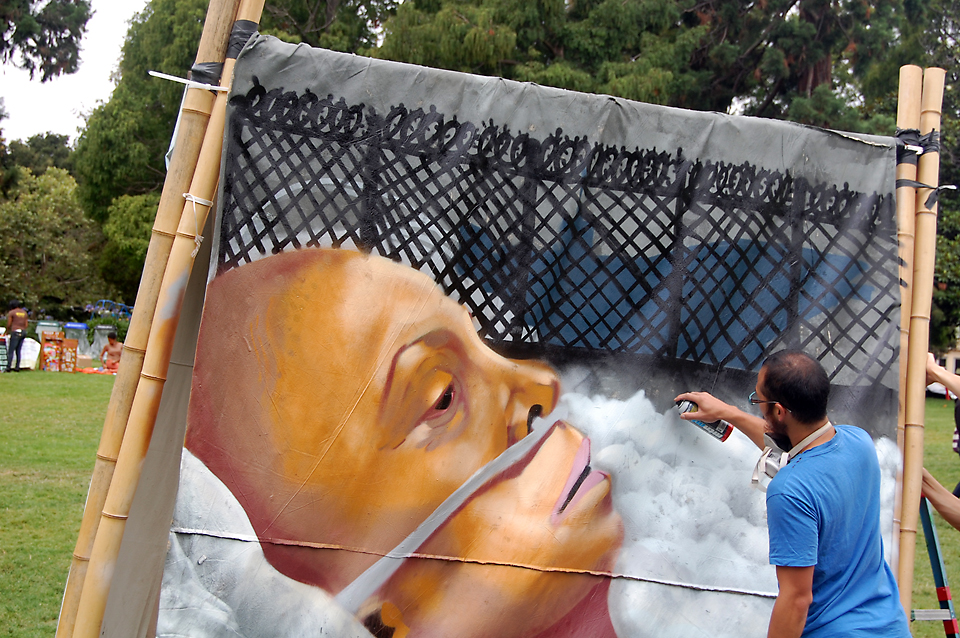
In the middle of the park stood three large paintings depicting people afflicted by environmental toxins. One man wearing a face mask stood before a long line of trucks, illustrating the urban asthma risk. Another painting showed a man in front of an oil refinery with an inhaler, also illustrating asthma risk. In the third, a cancer patient lies in bed in front of a polluted naval shipyard.
“They represent the toxic triangle, which is Oakland, San Francisco and Richmond,” said artist Dave Kim, 30. “If you look at any sort of poor community, you’ll see that they’re situated in a neighborhood that’s environmentally unhealthy, so it’s sort of a symptom of poverty.”
Kim said that the five-year-old
Community Rejuvenation Project, for which he works, is a effort to beautify abandoned areas: “I’m an artist, so that’s the way I can give my gift to Oakland.”