Plan Bay Area

Marin cities rebel against regional planning

Kelly O'Mara, SF Public Press — Jul 2 2012 - 11:02am

Corte Madera, population 9,300, kicked off a fierce debate in Marin over housing mandates earlier this year when the town council voted to become the first member to secede from the Association of Bay Area Governments. At the time, the nine-county planning agency (until then, made up of representatives of every Bay Area city) was launching a big regional housing-growth initiative called Plan Bay Area. Now, several local groups across the Bay Area are questioning the value of the regional plan, saying it will sacrifice local control.

With redevelopment's end, Bay Area cities scramble to keep grand plans alive

Alexis Fitts, SF Public Press — Jun 27 2012 - 2:10pm

Oakland's Auto Row renaissance may have to work on a smaller scale

Since 2000, city officials have had big plans for Auto Row. They called it the Broadway-Valdez project, a 96-acre development that included a strip of housing and restaurants next to the 19th Street BART station, the Valdez Triangle.Planners said the effort, if fully funded, would be Oakland’s best bet to revive its sagging retail sector. But the project’s prospects have dimmed since California killed redevelopment funds as a way of backfilling the state budget deficit.

Ever-changing population predictions frustrate Bay Area smart-growth planning

Maureen Nandini Mitra, SF Public Press — Jun 25 2012 - 11:38am

State and regional planning agencies have produced differing predictions of how many people will migrate to the Bay Area in coming decades. The disagreement is frustrating efforts to forge a consensus on how many hundreds of thousands of new homes to build across the region, and where. In May, the California Department of Finance took a fresh look at economic forecasts and officially backed away from its prediction that 9.5 million people would live in the Bay Area in 2040. The state now says it is likely to be closer to 8.4 million. But the Association of Bay Area Governments pegged the population for the same 2040 target date at a robust 9.3 million. The agency is charged with developing Plan Bay Area, an ambitious agenda to reshape the sprawling region by building 660,000 new homes in the urban image of walkable, transit-friendly San Francisco.

Map: Where we live now — 2010 household density and priority development areas

Darin Jensen, Madeleine Theriault and Mike Jones, SF Public Press — Jun 22 2012 - 11:34am

Part of the challenge facing regional planners, who wrote the 30-year Plan Bay Area, is that it is hard to predict future population growth. The current list of more than 200 potential priority development areas in the plan tracks established high-density zones closely, indicating that the Association of Bay Area Governments, the Metropolitan Transportation Commission and other regional agencies want to fill in developments in areas that are already highly urbanized or near mass transit lines, instead of in undeveloped or underdeveloped suburban settings. This map helps readers of the Public Press’s summer edition special project, Growing Smarter: Planning for a Bay Area of 9 Million, understand these trends.

Tea partiers and Occupiers make strange bedfellows opposing sprawl control

Maureen Nandini Mitra, SF Public Press — Jun 21 2012 - 12:22pm

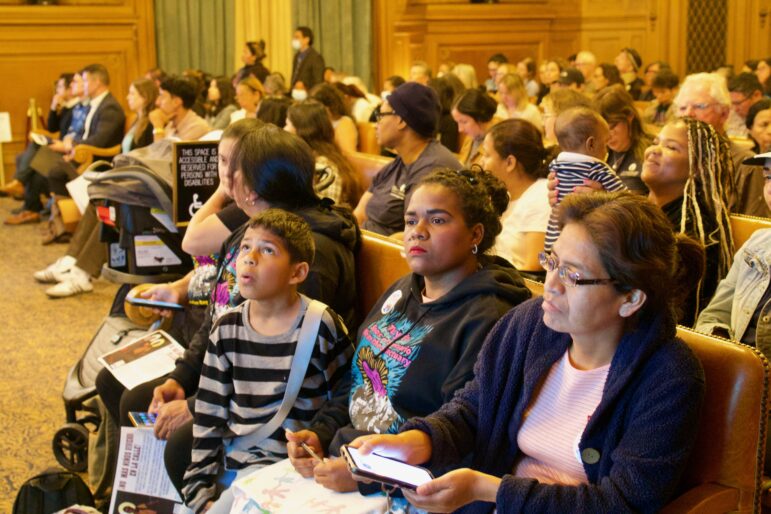
So far, Plan Bay Area — an ambitious regional blueprint for dense urban communities convenient for walking and public transit — seems to have more strident critics than defenders. Some libertarians, liberal Democrats, environmentalists, professional urban planners and anti-capitalist Occupiers have all found issue with parts of the plan, and the way its authors have sought public opinion.

Can San Francisco add 150,000 more people?

Alison Hawkes, SF Public Press — Jun 19 2012 - 10:55am

As the Bay Area struggles to meet sustainability goals, double-digit population growth presents a clear challenge to reducing the region’s ecological footprint. Residents must use resources more efficiently to counteract the addition of more than a million new residents. In many ways, it mirrors a challenge the planet is facing. Can population growth in San Francisco and the Bay Area be sustainable?

Officials say planning for regional smart growth prevents ‘a world of hurt’

Chase Niesner, SF Public Press — Jun 15 2012 - 9:21pm

The leaders of Bay Area planning agencies are struggling to persuade local governments and community groups that joint planning will make the region more socially, economically and environmentally healthy. Dealing with sprawl, the focus of the summer print edition of the Public Press, was front and center on Friday’s edition of “Forum,” the daily public-affairs talk show on KQED Radio.

Why smart growth?

Angela Hart, SF Public Press — Jun 14 2012 - 4:26pm

Sprawl is commonplace in the Bay Area — from places like Antioch and Brentwood on the outskirts of Contra Costa County to parts of Santa Clara and Sonoma counties. The pattern emerges from an all-too-familiar suburban formula that for decades earned developers high profits: perfectly manicured lawns, streets that meander around small neighborhood parks and cul-de-sacs at the end of nearly every block. Mixed use is forbidden — businesses are clustered into shopping malls a car trip away. Though the Bay Area started out on a European-style city grid in the era of the horse and buggy, the neighborhoods developed after World War II, after the rise of the automobile industry and interstate highway system, became the American dream.

Cities resist regional plan to limit sprawl

Angela Hart, SF Public Press — Jun 13 2012 - 1:44pm

A high-profile effort to focus new Bay Area housing into energy-efficient transit villages is seen as unworkable even as it makes its public debut this summer, say urban planners, because regional government lacks the authority to make cities build dense urban neighborhoods. The three-decade Plan Bay Area, unveiled in May, is the product of more than two years of research on the region’s demographics, economy, transportation and architecture. Proponents say “smart growth” could be the future of the Bay Area — if regional agencies had either the legal tools to enforce the grand vision or enough money to make it worthwhile for cities to participate.

Syndicate content